
Dubai is one of the most developed cities in the world that continuously upgrades its infrastructure to suit the blistering development and growing traffic. The city has also adopted an electronic toll system known as Salik in order to cope with the traffic. When you are on the road in Dubai, you must have noticed Salik gates that automatically withdraw a toll fee on cars that go through the gates. These gates are located strategically in important points within the city in order to manage the traffic flow. Dubai has 10 Salik gates, after Business Bay Crossing and Al Safa South opened in November 2024.
In this blog, I will explain to you everything you need to know about How Many Salik Gates are in Dubai. This is because it requires adding the information of where they are found, how they operate, and how they can be used. As a resident or a visitor, it is important to know Salik to have a comfortable driving experience in Dubai.
What is Salik?
Salik is an electronic toll road, which is a system initiated by the Roads and Transport Authority (RTA) in Dubai. Since its introduction in 2007, the system is expected to minimize congestion and control traffic and create revenue to maintain and develop the roads in the city. Salik does not require the use of physical toll booths. As an alternative, it relies on Radio Frequency Identification (RFID) technology, which automatically charges off tolls when vehicles go pass through specific toll gates.
Key Features of the Salik System
- Contactless Payment: Salik does not use cash and does not need to get out of his car to pay his dues in toll.
- RFID Stickers: Vehicles should be equipped with Salik tags to the windshields.
- Automatic Deduction: The amount to be paid as toll is automatically deducted by the prepaid Salik account.
- No Expiration: Salik tags have no expiry date and thus you do not need to replace Salik tags frequently.
- Simple Setup: It is possible to recharge and control via the RTA site or app.
Dubai’s Salik Gates: A Guide
There are 10 Salik gates present in Dubai which are situated at major highways and bridges that are essential in day to day commuting and long distance travel. These gates are crucial to alleviating any form of bottleneck in the flow of traffic in the city.
Salik gates in Dubai are all 24-hour operations. Since 31 January 2025 the toll depends on the time of day: AED 6 at peak (6 to 10 AM and 4 to 8 PM, Monday to Saturday), AED 4 off-peak, and free from 1 AM to 6 AM, with a flat AED 4 on Sundays. Check salik.ae for the current timetable.
Below is a guide to the original eight Salik gates, followed by the two added in November 2024, Business Bay Crossing and Al Safa South:
1. Al Maktoum Bridge (Umm Hurair Road)
This Salik gate is located on the iconic bridge Al Maktoum which is strategically located to control traffic in Umm Hurair and Dubai Marina. One of the large crossings of the Dubai Creek is the bridge, and the Salik gate can be found here to alleviate congestion during the rush hours.
Why is it Important
- Linking key business areas such as Deira and Bur Dubai.
- Provides a new line of escape to avoid the traffic in other bridges.
Toll Gate Instructions
- Make sure that your car is tagged with Salik.
- When you go through this gate, the toll (AED 4 or AED 6 depending on the time of day) is deducted.
2. Al Garhoud Bridge (Sheikh Rashid Road)
The other important crossing bridge in the Dubai Creek is the Al Garhoud Bridge. The Salik gate at this location falls on the Sheikh Rashid road that joins Sheikh Zayed Road and Al Khail Road. This bridge is among the busiest in the city, especially during morning and evening rush hours.
Why is it Important
- One of the essential paths used in commuting to and out of the Dubai International Airport.
- The central business districts of Dubai can be reached very fast via a single route.
Toll Gate Instructions
- Ensure your Salik account is active before crossing.
- The toll (AED 4 or AED 6 depending on the time of day) will be deducted when you pass through the gate.
3. Al Mamzar North (Al Ittihad Road)
This Salik gate is situated in the Al Ittihad Road, which is north of the Al Mamzar Beach Park. The Al Mamzar North Gate assists in controlling traffic to drivers who are heading to Sharjah particularly during rush periods where traffic congestion is a normal occurrence.
Why is it Important
- It is one of the major roads used by people traveling between Dubai and Sharjah.
- Lessens road congestions at the Al Ittihad Road.
Toll Gate Instructions
- Drive under the gate; the toll (AED 4 or AED 6 depending on the time of day) will automatically be deducted.
- Ensure you have a working Salik tag.
Read Also: Dubai Mall: 15 Must-Do Adventures for All Ages
4. Al Mamzar South (Al Ittihad Road)
This gate is located on the Al Ittihad Road, and it is situated south of the Al Mamzar Beach Park and it helps to regulate traffic in the opposite direction as in the case of the Al Mamzar North Gate. It is a key element among motorists who travel towards Dubai in Sharjah.
Why is it Important
- Balances the movement between Sharjah and Dubai.
- Minimizes time wastages among the drivers entering the city.
Toll Gate Instructions
- As any Salik gates, have a minimum balance in your account.
- The toll (AED 4 or AED 6 depending on the time of day) is charged automatically when you pass through.
5. Al Safa (Sheikh Zayed Road)
The Al Safa Salik Gate lies close to the busy Sheikh Zayed road on the Al Safa intersection. Sheikh Zayed road is the main road of Dubai that links various business districts, shopping centers and residential localities.
Why is it Important
- Calms down traffic congestion on Sheikh Zayed Road, particularly during the rush hours.
- The intersection where all roads head out of the downtown area of Dubai towards the outskirts.
Toll Gate Instructions
- Pass the gate and AED 4 will be subtracted.
- Ensure your Salik tag is installed correctly.
6. Airport Tunnel (Beirut Street)
This Salik gate is located in the Airport tunnel in Beirut Street and it caters to the passengers and staff who come in and out of Dubai International Airport. The tunnel offers underground way that lessens the traffic of the surface on the vicinity of the airport.
Why is it Important
- Critical to the airport traffic control.
- Reduces congestion around one of the busiest airports in the world.
Toll Gate Instructions
- As you pass through the tunnel, AED 4 is deducted from your account.
- Double-check your Salik balance if you frequently travel to the airport.
7. Al Barsha (Sheikh Zayed Road)
The Al Barsha Salik Gate is situated in the Sheikh Zayed Road, close to the intersection of Al Barsha and regulates traffic in one of the busiest residential and commercial areas in Dubai. The Mall of the Emirates, along with various hotels and businesses, is one of the famous tourist destinations of Al Barsha.
Why is it Important
- Relieves the main thoroughfare of traffic between the residential and the city center.
- One of the key entry points to Al Barsha or Jumeirah residents.
Toll Gate Instructions
- Like other gates, AED 4 will be deducted as you drive past.
- Make sure your Salik tag is properly registered.
8. Jebel Ali (Sheikh Zayed Road)
Jebel Ali Salik Gate is on the southern section of the sheikh Zayed road near the intersection of Jebel Ali. It is a significant industrial center where there is Jebel Ali Port and Free Zone.
Why is it Important
- The major in terms of traffic control over heavy duty and commuters to industrial localities.
- Helps in controlling traffic congestion on the outskirts of Dubai.
Toll Gate Instructions
- AED 4 is deducted when passing through the gate.
- Make sure that you have your Salik tag operating, particularly when you are a regular commuter within this location.
How Does Salik Work?
Step-by-Step Guide Ontosing Salik
- Purchase a Salik Tag:
- Salik tag is sold in petrol stations, through the RTA site online or at Saat-like customer service centres.
- Install the Tag:
- The Salik tag is to be installed on the inner window of your car, near the back-view mirror.
- Activate the Tag:
- After buying the tag, you have to activate it either in the Salik website or the Salik app. You will be required to give your vehicle registration so as to have the tag linked to your account.
- Recharge Your Account:
- Always make sure that your Salik account is stocked. One may recharge online, with the RTA app or at certified centers.
- PaPass-Through Gate:
- When you pass through any of the Salik gates, it will automatically recognize your car and the system will deduct AED 4 in your Salik account.
How to Check Your Salik Balance
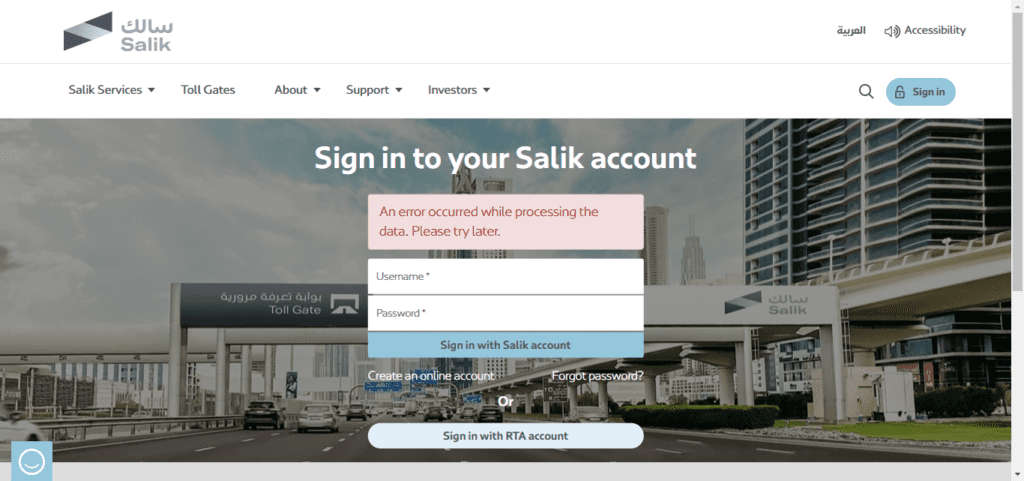
- Log in to the Salik website or the RTA mobile app to check your balance and account activity.
- One more thing you can do with SMS services is to have updates on your Salik account.
What Happens If You Don’t Have a Salik Tag
Passing a Salik gate with no registered tag or enough balance will translate to fines. The fine for passing a gate without a registered tag, after the 10-working-day grace period, is AED 100 for the first offence, AED 200 for the second and AED 400 for each one after that (one fine per vehicle per day). If your balance is too low and you do not recharge within five working days, the fine is AED 50. It would be advisable to maintain good practice on your account so as to avoid unnecessary fines.
How to Recharge Your Salik Account
- Online: Use the Salik website or RTA app.
- SMS: Recharge through SMS by linking your phone number to your account.
- Bank Apps: Many banks offer direct recharge options through their mobile apps.
- In-Person: Recharge at petrol stations or Salik service centres.
Read Also: Dubai Car Ownership Transfer: Simplified
Salik Gates in Dubai: What Has Changed Since This Guide Was Written
Toll rules in Dubai have moved on, and a couple of points above are now out of date. According to Wikipedia’s Salik article, Salik opened on 1 July 2007 with two gates, and two more gates opened in November 2024, bringing the total to ten. The two newest are Business Bay Crossing and Al Safa South. The full list on Wikipedia is Al Barsha, Al Garhoud Bridge, Business Bay Crossing, Al Maktoum Bridge, Al Mamzar South, Al Mamzar North, Al Safa South, Al Safa North, Airport Tunnel and Jebel Ali.
Variable pricing since January 2025
The toll is no longer a flat AED 4 at every hour. CITTI Magazine reports that variable pricing took effect on 31 January 2025 across the network:
| Period | Hours | Rate (AED) |
|---|---|---|
| Peak | 6am to 10am and 4pm to 8pm | 6 |
| Off-peak | 10am to 4pm and 8pm to 1am | 4 |
| No charge | 1am to 6am | 0 |
| Sundays (not public holidays or major events) | All day | 4 flat |
Ramadan has a separate schedule, with a peak rate of AED 6 from 9am to 5pm and no charge from 2am to 7am, according to the same report. Always check the official Salik site for the timetable that applies today.
One charge for paired gates
If you cross the Al Mamzar North and South gates, or the Al Safa North and South gates, within one hour in the same direction, you are only charged once. This helps drivers who clip two gates on one trip.
Why the gates exist
Salik Company PJSC became a public joint stock company on 5 July 2022. Wikipedia quotes Salik as saying tolled roads cut average journey times by 44 percent, and that Sheikh Zayed Road traffic fell 9 percent at peak hours after dynamic pricing. Treat those as company figures. For account tools and violation handling, use the official Salik website.
Background on how the system grew
Per Wikipedia, Salik started with two gates in 2007, added two more in September 2008, then Al Mamzar and the Airport Tunnel gates in April 2013 and Jebel Ali in October 2018. Knowing the history explains why older maps and articles, including parts of this one, show fewer gates.
Practical tips
- Check your route against the ten-gate list before you leave, especially if you use Business Bay or Al Safa.
- If you can move a trip outside 6am to 10am and 4pm to 8pm on weekdays, the toll is lower.
- Keep your balance topped up, because plate cameras will still record a crossing if your tag does not read.
Related guides
- UAE Traffic File Number – What It Is & How to Find Yours
- Abu Dhabi External Fines: A Complete Guide
- Check Salik Balance via SMS, Plate or Online in 2026
- Register Salik in UAE: Fast & Easy Guide
- How to Invest in Salik’s IPO: A Step-by-Step Guide
Final Words
Salik system in Dubai is an important component of the control of the traffic movement in the city, particularly in such large highways as Sheikh Zayed Road and bridges like Al Garhoud and Al Maktoum. You can understand the working of the system and the position of the gates so that you are not stuck in the traffic and move without hassles within Dubai. Ensure that your Salik tag is on and you know where these gates are located so that you can have a smooth ride in the city.


