Industrial sites don’t generate waste the way offices or retail stores do. Production runs create scrap, packaging, and offcuts by the ton, not the bag, and small bins simply can’t keep up. Facilities that rely on undersized containers usually end up with overflow, blocked walkways, and staff spending more time managing trash than doing their actual jobs.
Large waste containers solve this problem at the source. Instead of constantly emptying small bins throughout the day, industrial sites consolidate waste into fewer, higher-capacity units built to handle the volume and weight that production actually generates.
Many facilities across the UAE work with Crateco Pack LLC to source large-capacity containers suited to industrial waste volumes, since the right container has a direct impact on how smoothly daily operations run.
What Counts as a Large Waste Container?
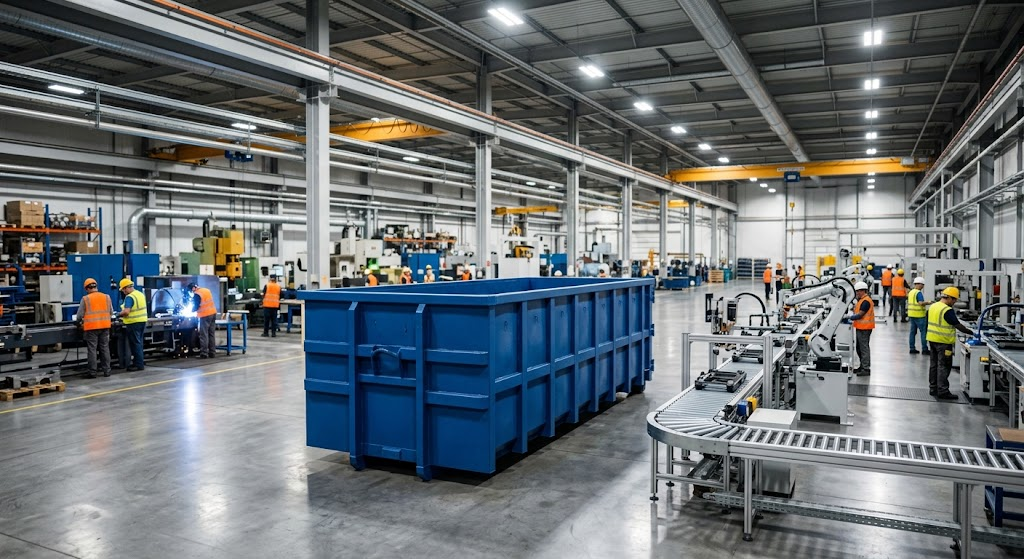
Large waste containers are high-capacity units designed to hold significantly more waste than standard bins, ranging from bulk wheeled containers to roll-off dumpsters and stationary compactor units. Unlike small office or break room bins, they’re built for continuous industrial use, heavy loads, and frequent handling by machinery rather than by hand.
These containers are typically placed at central collection points, near production lines, loading docks, or designated waste zones, where they consolidate material from multiple areas of a facility before a hauler removes it.
Why Industrial Sites Need Larger Waste Solutions
A manufacturing plant or distribution center can generate more waste in a single shift than a small office produces in a month. When container capacity doesn’t match that output, the result is predictable: bins overflow before collection day, staff resort to piling waste on the floor, and the whole site starts to look and function less efficiently.
Matching container capacity to actual waste volume isn’t just about tidiness. It affects safety, labor costs, and how often a facility needs to pay for collection services in the first place.
How Large Waste Containers Improve Industrial Waste Management
1. Fewer Collection Trips, Lower Hauling Costs
Waste haulers often charge per visit, per volume, or both. A container that holds significantly more waste means fewer scheduled pickups, which directly reduces hauling expenses over time.
For sites generating waste daily, this adds up quickly. Cutting collection frequency in half can meaningfully lower a facility’s monthly waste management costs without changing anything else about the operation.
2. Centralizes Waste From Multiple Areas
Industrial sites often generate waste in several locations at once, production lines, packaging stations, loading docks. Without a central collection point, waste ends up scattered across the facility in whatever small containers happen to be nearby.
A large container gives every area a single destination for waste, which simplifies internal transport and keeps material from piling up in places it was never meant to sit.
3. Reduces Manual Handling and Injury Risk
Constantly emptying small bins means workers are lifting, carrying, and bending far more often than necessary. Large containers, especially wheeled or mechanically emptied units, cut down on how frequently staff need to physically move waste.
This matters for workplace safety. Fewer manual lifts and shorter, less frequent trips to a collection point reduce the strain-related injuries that come with repetitive handling.
4. Built to Handle Heavy, Bulky Industrial Materials
Standard bins aren’t designed for the weight and volume industrial waste produces, whether that’s metal offcuts, packaging bulk, or production scrap. They crack, warp, or simply can’t hold the load.
Facilities generating heavy industrial waste often move to a reinforced garbage bin from trusted manufacturers like Crateco Pack LLC built for this kind of daily strain, since standard containers wear out far faster under constant industrial use.
5. Keeps Work Areas Cleaner and Safer
Overflowing bins and scattered waste create genuine hazards on an industrial site, blocked walkways, tripping risks, and forklift routes cluttered with debris. Large containers absorb higher waste volumes without spilling over between collections.
A cleaner site isn’t just about appearance. It directly affects how safely equipment can move and how easily staff can do their jobs without navigating around waste that shouldn’t be there.
6. Improves Waste Segregation at Scale
Sorting waste into paper, plastic, metal, and general categories only works if each stream has enough capacity to avoid mixing. Small bins fill up fast and tempt staff to combine waste types just to keep things moving.
Larger, clearly labeled containers for each material type make it realistic to maintain proper segregation even when a facility is producing waste continuously throughout the day.
7. Supports Higher Production Volumes Without Overflow
As production scales up, so does the waste that comes with it. A container system sized for a smaller operation quickly becomes a bottleneck once volumes increase, leading to overflow and rushed, inefficient collection schedules.
Large containers give facilities breathing room to handle production increases without needing to immediately overhaul their entire waste setup.
8. Works With Existing Material Handling Equipment
Large industrial containers are typically designed to integrate with forklifts, hydraulic bin dumpers, and standard collection trucks. This compatibility means waste can move through a facility using equipment that’s already part of daily operations.
Containers that don’t fit existing handling equipment create extra steps, and sometimes extra risk, every time waste needs to be moved or emptied.
9. Reduces Odor and Pest Issues in Storage Areas
Waste sitting in small, frequently overflowing bins tends to create odor and pest problems faster than waste consolidated in larger, well-sealed containers. Fewer open bins scattered around a site means fewer places for these issues to start.
Secure lids on large containers also help control exposure, which matters most in facilities handling food waste, packaging residue, or other materials that attract pests when left uncovered.
10. Creates More Predictable Waste Management Costs
When container capacity matches actual waste output, collection schedules become consistent instead of reactive. Facilities can plan around a predictable pickup frequency rather than scrambling for emergency collections when bins overflow unexpectedly.
That predictability makes it easier to budget for waste management as a fixed operational cost rather than a recurring surprise.
Industrial Sites That Rely on Large Waste Containers
Large-capacity waste containers are used across a wide range of industrial operations, including:
- Manufacturing plants and production facilities
- Warehouses and distribution centers
- Construction and demolition sites
- Food and beverage processing plants
- Automotive and assembly facilities
- Ports and logistics hubs
While the waste generated at each of these sites looks different, the underlying need is the same: enough capacity to keep pace with continuous, high-volume operations.
Features That Make Large Containers Effective on Industrial Sites
Not every high-capacity container performs equally well in demanding industrial conditions. Useful features to look for include:
- Reinforced walls that resist cracking under heavy loads
- Wheeled or mobile bases for easier repositioning
- Compatibility with forklifts or hydraulic lifting equipment
- Weather-resistant construction for outdoor placement
- Secure, well-fitted lids to control odor and pests
- Stackable or nestable designs for space efficiency
These features determine how well a container performs day to day, not just how much it can technically hold.
Conclusion
Waste management on an industrial site rarely improves by adding more small bins. It improves by matching container capacity to what the operation actually generates, reducing how often waste needs to be handled, moved, and collected.
Facilities that invest in the right large-capacity containers spend less time managing overflow and more time running operations the way they’re meant to, clean, organized, and without waste becoming a daily obstacle.